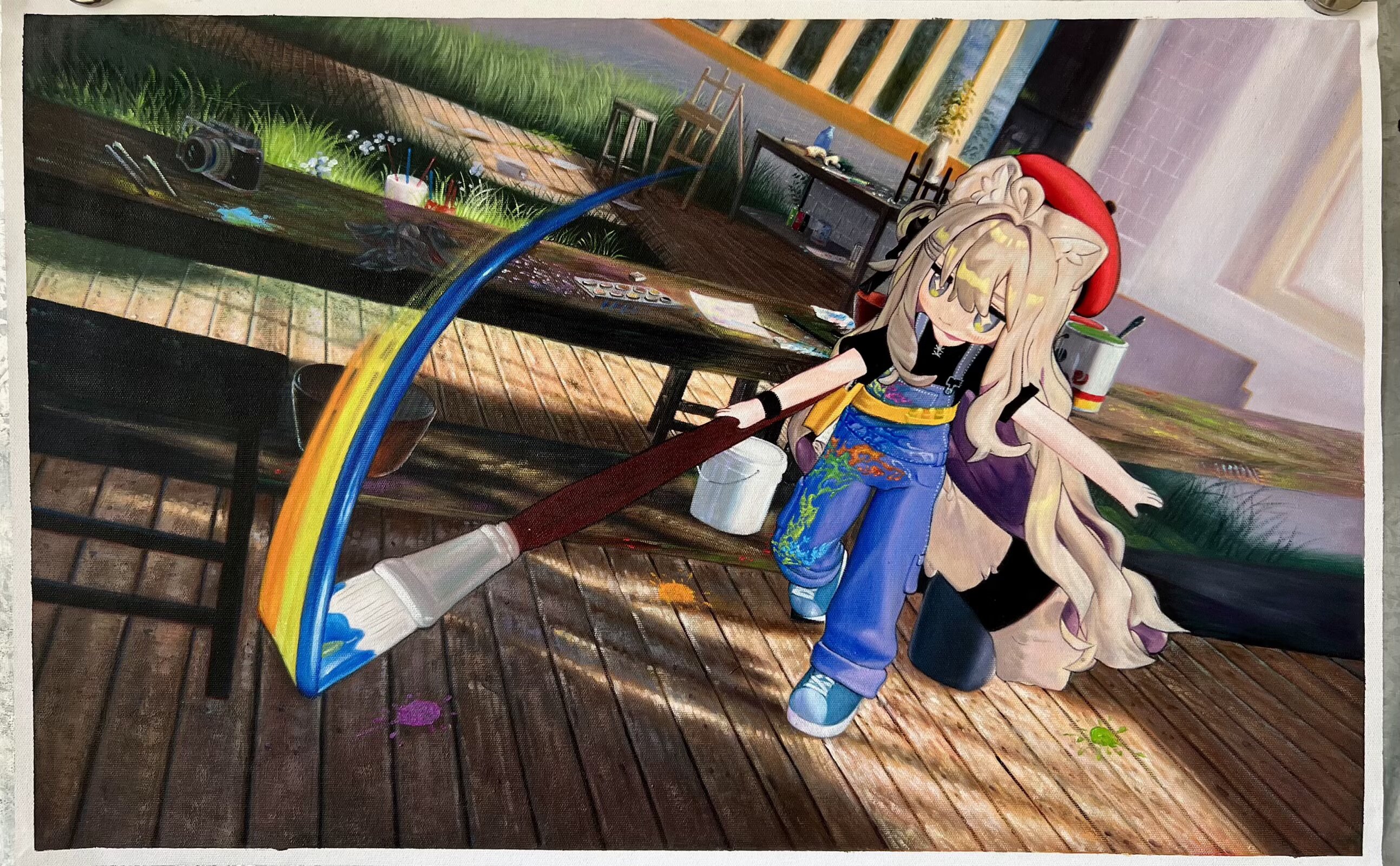
The painter's afternoon begins with a single act of surrender — letting the brush do what it wants, where it wants. On the wooden floor, three colours have escaped: a red that came from a beret, a yellow that bounced off the sun, and a blue that has been waiting all morning to make this mess.
She is small, hunched, intent. The beret is the only thing on her that isn't covered in pigment. Everything else — overalls, hands, the hem of her dress — is now a record of what the brush decided to do while no one was watching.
The floor is honest. It catches the spillage, the drip, the little accidents that no composition would ever allow. We look at the painting and feel like we've walked in at the wrong moment — the moment when an artwork is still being made, before it has been decided to be art.
And yet here it is. Decided. Hung. Witnessed.
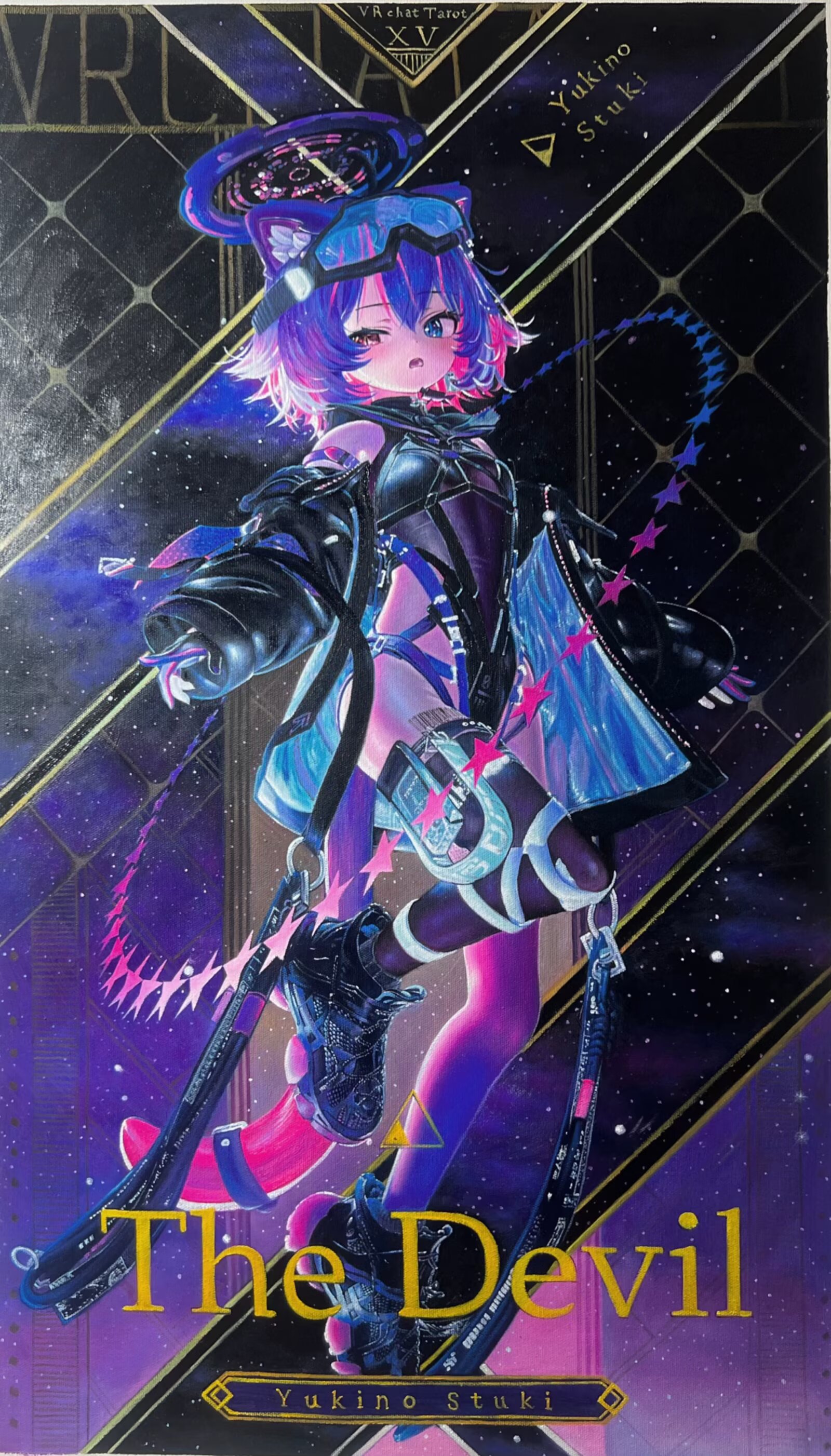
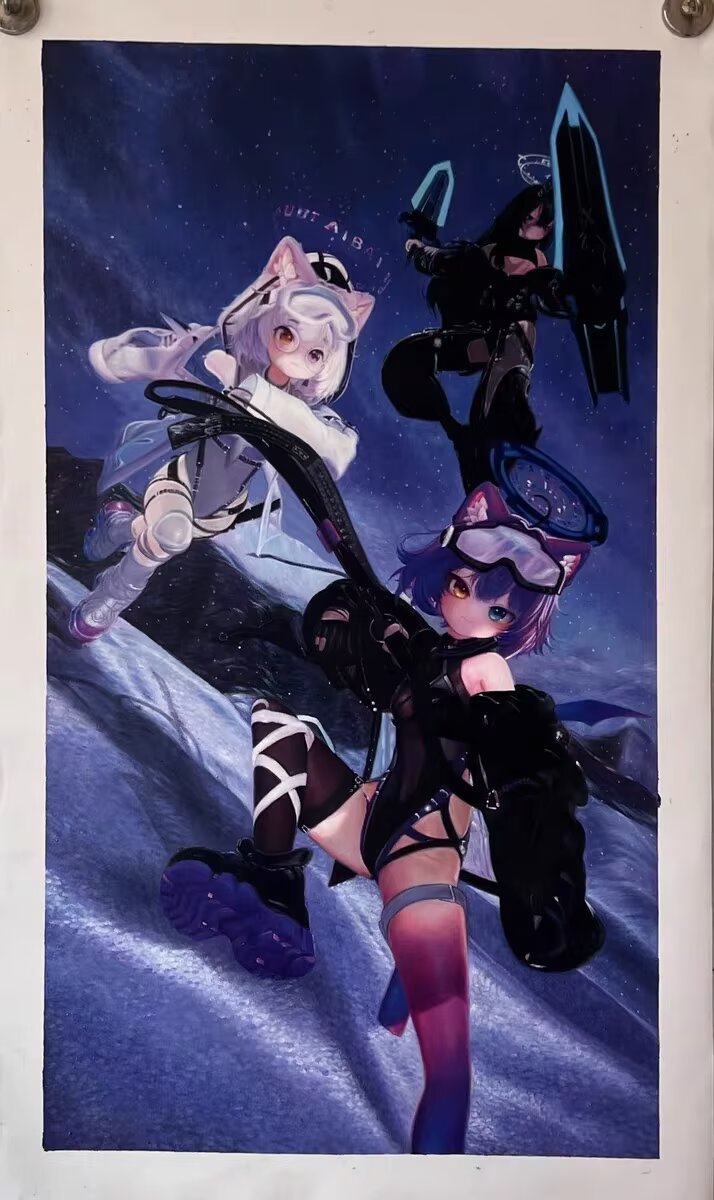
Tarot card XV, the Devil, has always been the card about attachment — what chains us, what we mistake for freedom. Here, Yukino Stuki stands inside that idea rather than outside it. The card is not warning her; the card is her habitat.
The composition borrows from the gold-foil tarot revival of the late 2010s: angular frame, the lettering in serif gold, a halo or two where a halo shouldn't be. The pink trail of arrows cuts diagonally across the figure, the only warm note in an otherwise cool cosmos.
The most interesting thing about this card is that the Devil is not depicted as threatening. She is postured, contained, almost self-possessed. The frame restrains her; the geometry restrains her. The pink arrows rest her. We look at her, and the only thing we read is: she knows what she's doing here.
Aria — an air, a song, a duet performed not by two voices but by two skies. The composition splits the frame down the middle: on the left, a figure in pale hair drifts through soft snow; on the right, a darker figure trails starlight through a deep-purple void.
The two halves are not opposites. They are the same scene at different temperatures — one a winter afternoon, one a winter night. The viewer's eye moves from one to the other and back, like listening to a phrase answered by its echo.
The hair and the star trail are the same gesture, drawn in different ink. The snow and the nebula are the same quiet, rendered in different scales. The piece is less a portrait of two characters than a portrait of resonance — the way two things can be themselves, completely, and still belong to the same song.
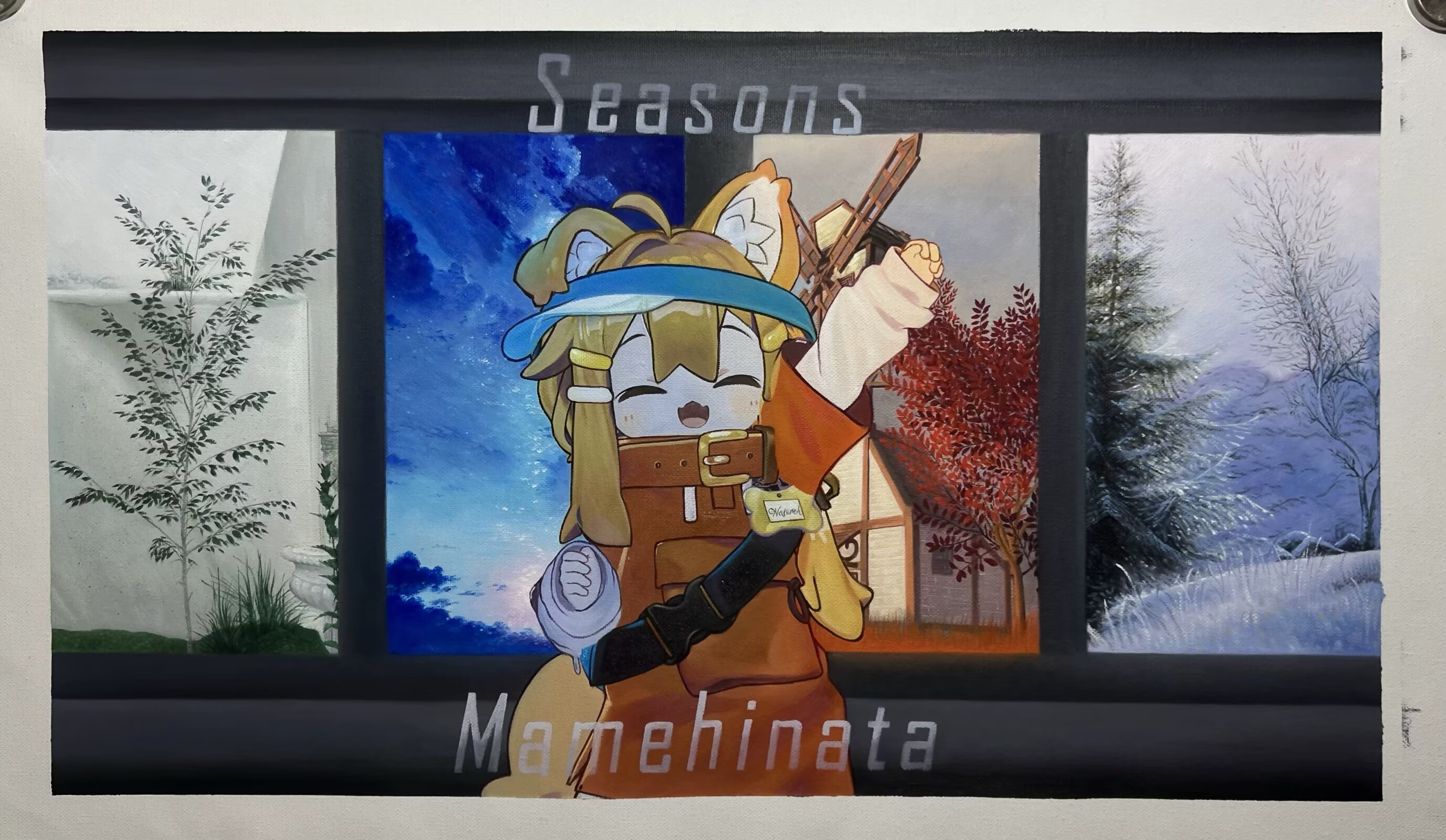
Four windows, one girl. Spring on the far left, summer in the middle-left, autumn middle-right, winter far right. The progression reads across the frame the way a calendar does — left to right, light to dark to light to cold.
Mamehinata is the subject of all four windows, but she's also the only thing that stays still while the weather changes around her. Her blue headband, her orange overalls, her soft smile — these are constants in a world that keeps spinning through its four moods.
The windows themselves look like film stills. Each one a moment, a season paused, a colour that we associate with a month of the year. Together, they are not so much a portrait of Mamehinata as a portrait of time — the way time uses colour to mark itself.
She is, in the end, just the witness. The seasons are the painting.
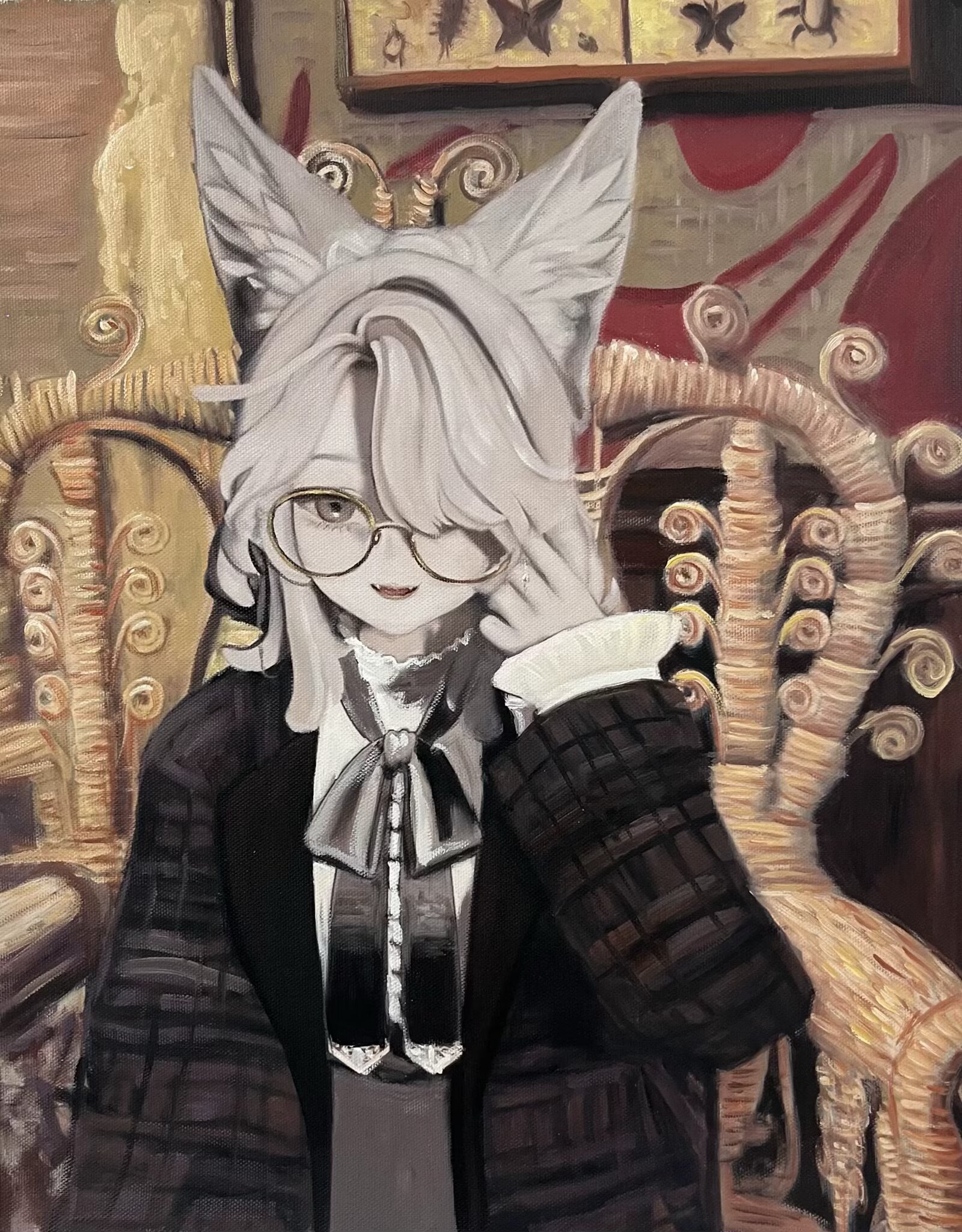
Silver hair. Round glasses. A black dress, formal, almost Victorian. Behind her, a heavy gold frame is being constructed — or perhaps dismantled — in warm brown brushstrokes. Inside the frame, butterflies and the suggestion of a smaller picture.
This is the most traditional of the five pieces — closest to charcoal, to a museum wall, to the kind of painting that hangs behind a velvet rope. Yet the frame is not finished. It is still being painted, around her, by her, for her.
The small smile is the puzzle. She knows the frame is incomplete. She knows we are watching her be incomplete. And she is amused by this — not in a cruel way, but in the way an artist is amused when they catch the viewer paying attention to the wrong part of the painting.
We were meant to look at the frame. We are looking at her. She is letting us.
Note